My Life Portfolio — Beyond Code and AI | Original
A developer’s life is more than commits and model training runs. This post documents the non-technical dimensions of my journey — the experiences, failures, and milestones that shaped who I am beyond the terminal.
🏠 Childhood in Meizhou
I was born in 1995 in Meizhou, Guangdong — a small city known for Hakka culture. My primary school invited a photographer to take class photos. Looking at these now, I see a kid who had no idea he’d end up training neural networks on GPUs three decades later.
 Primary school photo, Meizhou
Meizhou wasn’t a tech hub. No hackathons, no startup meetups, no developer communities. Just mountains, Hakka food, and a kid who was curious about everything. That curiosity would eventually drive me to teach myself programming, drop out of university, and chase a career in software — but it started here, in a small city where the biggest technology event was getting broadband internet.
🏆 NOIP — My First Programming Contest
In high school, I participated in the National Olympiad in Informatics (NOIP) — China’s competitive programming contest for high school students. We traveled from Guangzhou to Zhongshan for the provincial competition.
The exam was on Windows XP (a relief after spending days learning Linux). I sat next to Chen Yixiang from Shantou, who coded effortlessly while I struggled with my first question — trying to allocate a 100,000×100,000 array and being told by C++ that it wasn’t happening.
I didn’t win any medals. But the experience taught me something important: I loved solving problems with code, even when I was bad at it. And I was surrounded by people who were much better than me, which was both humbling and motivating.
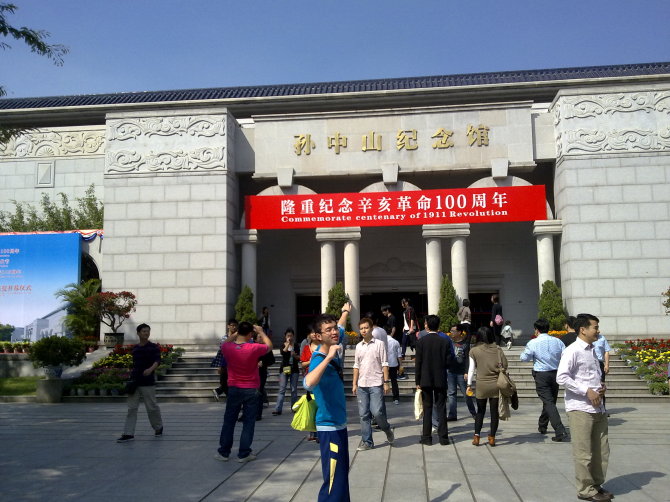 NOIP Competition in Zhongshan, 2011
🚀 Dropped Out at 20 — The LeanCloud Years
After high school, I entered Beijing Forestry University. But university felt slow. I was building Android apps, winning hackathons, and getting internship offers. At 19, I interned at LeanCloud — a cloud platform startup co-founded by a Yale PhD who had worked at Google.
I learned more in 6 months at LeanCloud than in 2 years of university. The team included ex-Google, ex-Alibaba, ex-Wandoujia engineers. Dennis, the tech lead, had open-source projects used by JD and Tencent. My CEO had left a comfortable life in the US to build a developer platform in Beijing.
I dropped out. My parents weren’t thrilled. But I knew I was on a path that university couldn’t offer — learning from people who had built real products at scale.
 Beijing Forestry University — Official withdrawal decision, October 2015
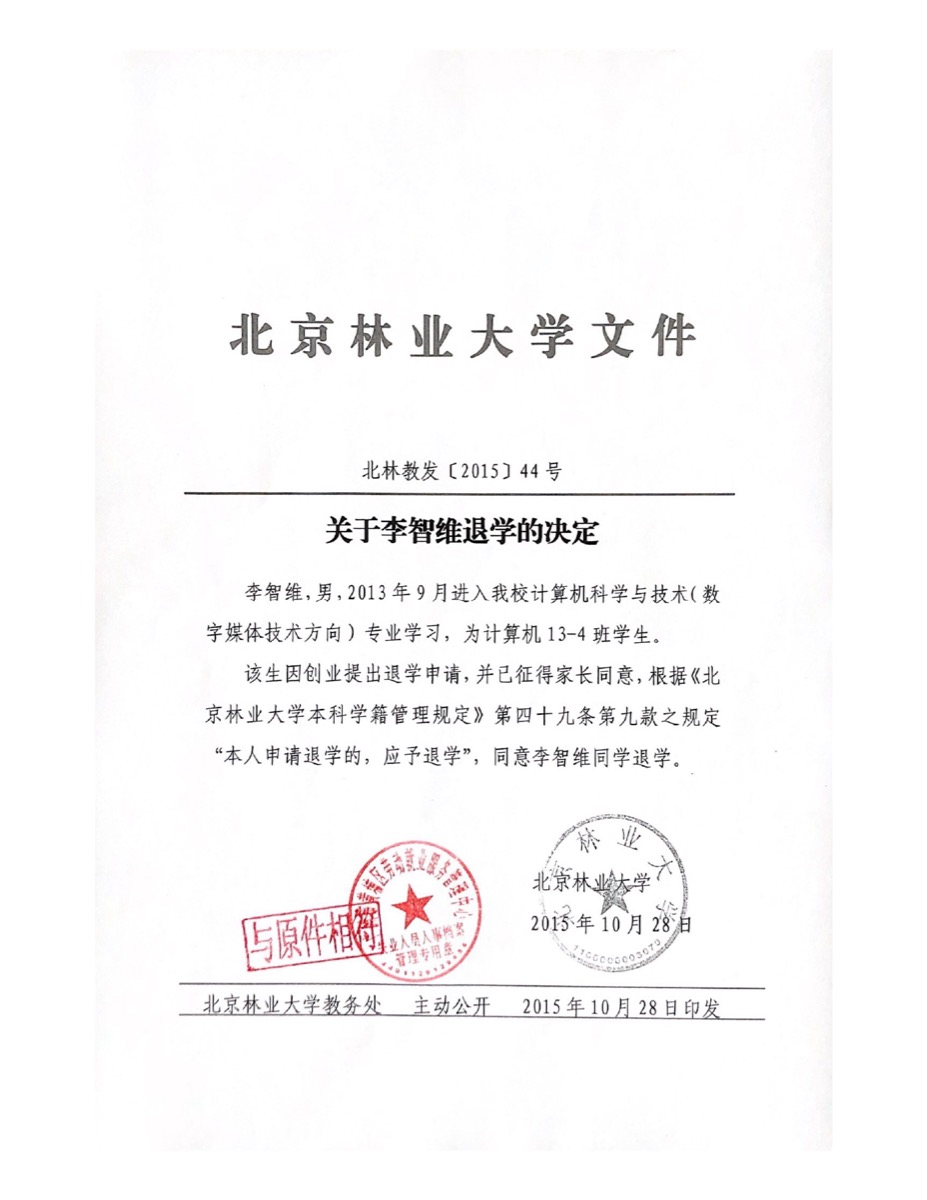 Document detail — “applied for withdrawal to pursue entrepreneurship”
💼 CEO at 21 — The Startup Dream
At 21, I quit a 25K/month salary to start my own company. Inspired by Paul Graham’s essays and Y Combinator’s ethos, I flew to Silicon Valley, visited Google’s campus, walked through YC’s office, and met young founders from MIT, Stanford, and Tsinghua.
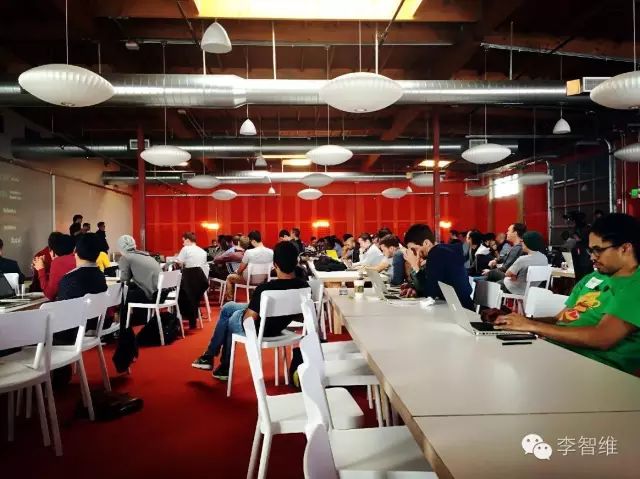 Y Combinator visit, Silicon Valley, 2016
I partnered with Ye Gucheng (叶孤城), a popular iOS community figure, to build Reviewcode.cn — a code review platform. We got 8,000 daily PVs within weeks. But the product wasn’t a strong enough need. We pivoted to offline training and workshops, then to software outsourcing.
The Silicon Valley trip changed my perspective. I met people who had left Google to build startups, who lived in shared houses and coded 16 hours a day. I met the CTO of Malong Technologies — a Microsoft veteran with top-tier conference papers — who told me at 2 AM on a Suzhou Street sidewalk: “Young man, have patience. Build your core skills. To do world-class work, you need not just curiosity, but the ambition to change the world.”
📈 From Losing ¥450K to Earning ¥2M Revenue
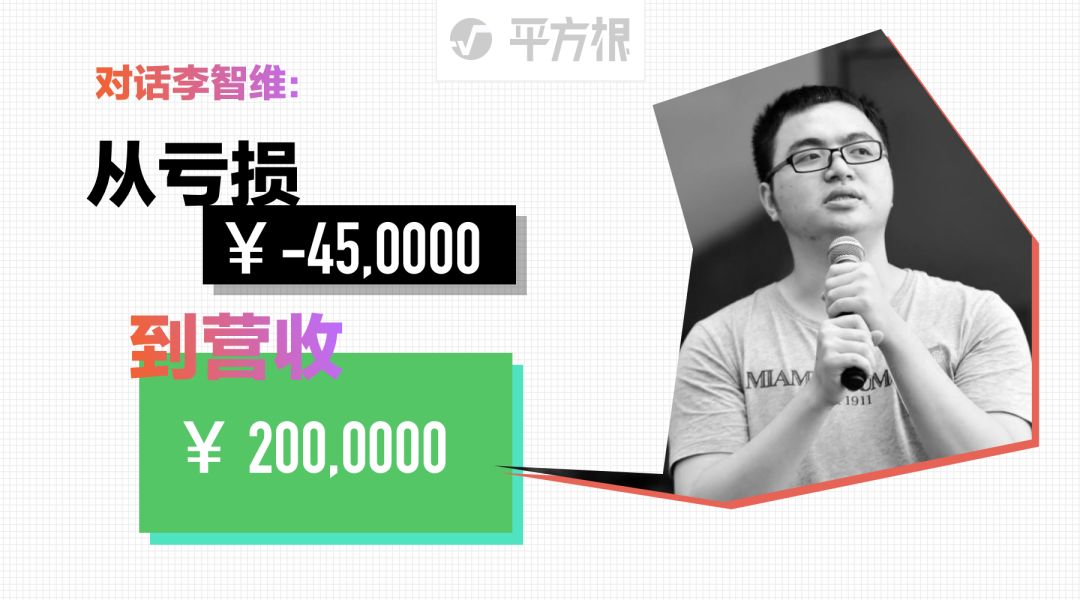
The startup journey wasn’t smooth. After receiving a ¥500K investment from Li Xiaolai (李笑来), I made classic first-time founder mistakes: hired too fast, managed too loosely, spent too freely. I felt like a CEO and stopped doing the hard work myself. Within months, I had burned through ¥450K.
The failure was painful but educational. I learned that:
- Founders must do the core work themselves in the early stage
- Don’t hire before you have a clear business model
- Easy money corrupts — when cash comes too easily, you lose discipline
I rebuilt. Pivoted to software outsourcing, personally took on every client call, every project review, every line of critical code. By 2018, the company had:
- ¥2M+ in revenue (first half of 2018)
- ¥500K+ profit
- 40+ completed projects for clients like Xiaoyuan Souti (小猿搜题) and Cogtu (中科视拓)
- A team of 15 full-time and part-time engineers
The key insight: outsourcing isn’t glamorous, but it teaches you how business actually works — finding clients, managing expectations, delivering on promises, and building trust.
👥 AI & Fun Live — The Engineer Community
Fun Live was more than a live-streaming platform — it became a community. Around 2016-2017, as we hosted lectures on programming, design, and tech, users gathered in WeChat groups. What started as notification channels for upcoming talks evolved into something much larger: a network of roughly 3,000 engineers across 27 WeChat groups.
The composition tells the story of China’s tech scene at that time: about three-quarters iOS engineers, the rest Android developers, machine learning practitioners, startup founders, and internet professionals. These were people building the mobile internet in real time — the apps, platforms, and services that millions of Chinese users relied on daily.
We hosted around 80 lectures with 30,000 users and millions of page views. After each talk, the speaker would join the WeChat group for a short Q&A — a tradition that kept the groups alive long after the live stream ended. The groups became a persistent layer of technical discussion, job referrals, and peer support that outlived the platform itself.
Even today, these groups remain active. I share materials across all 27 groups — different audiences, different discussions, but the same spirit of learning in public. The community taught me something the business metrics didn’t capture: the most valuable thing you can build isn’t a product — it’s a room full of people who want to learn from each other.
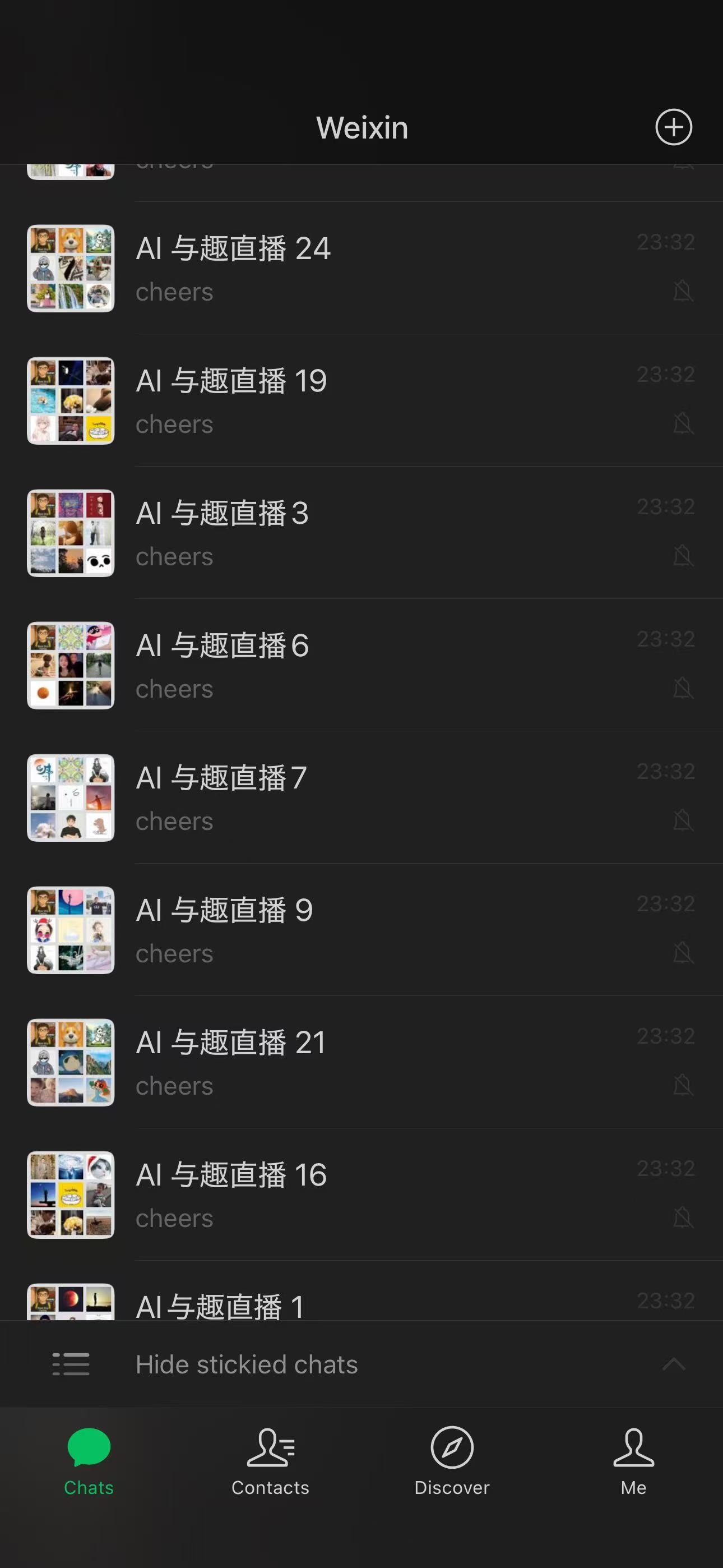 WeChat groups — AI & Fun Live, still active since 2016
🌏 Silicon Valley & America
My first trip to Silicon Valley in 2016 was transformative. I visited Google, Stanford, the Computer History Museum, and Y Combinator. I watched an NBA game, walked across the Golden Gate Bridge, and had conversations with people from completely different backgrounds.
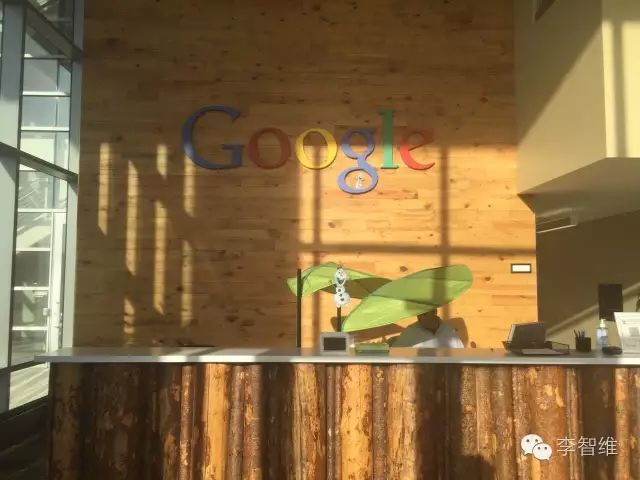 Computer History Museum, Silicon Valley
 Stanford University campus
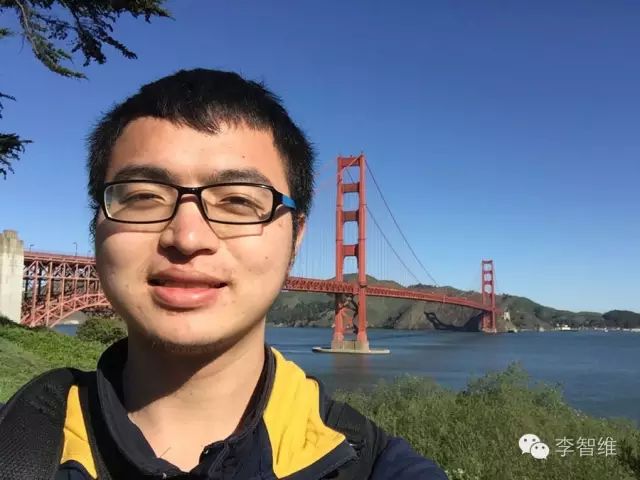 San Francisco exploration
What struck me most wasn’t the technology — it was the mindset. People in Silicon Valley talked about changing the world as if it were a normal career goal. They failed openly, learned publicly, and built with a speed I had never seen in China’s tech scene.
My Airbnb host told me about following Steve Jobs since Apple went public in 1984. “High technology is for young people,” he said. I realized that the stories I had read about in books were happening in the neighborhoods around me.
📝 IELTS — Proving English Proficiency
In January 2026, I took the IELTS Academic test. For someone who learned English primarily through reading technical documentation and watching YouTube videos, it was both a validation and a reality check.
Scores:
| Skill | Band |
|---|---|
| Listening | 6.0 |
| Reading | 8.5 |
| Writing | 6.0 |
| Speaking | 5.0 |
| Overall | ~6.5 |
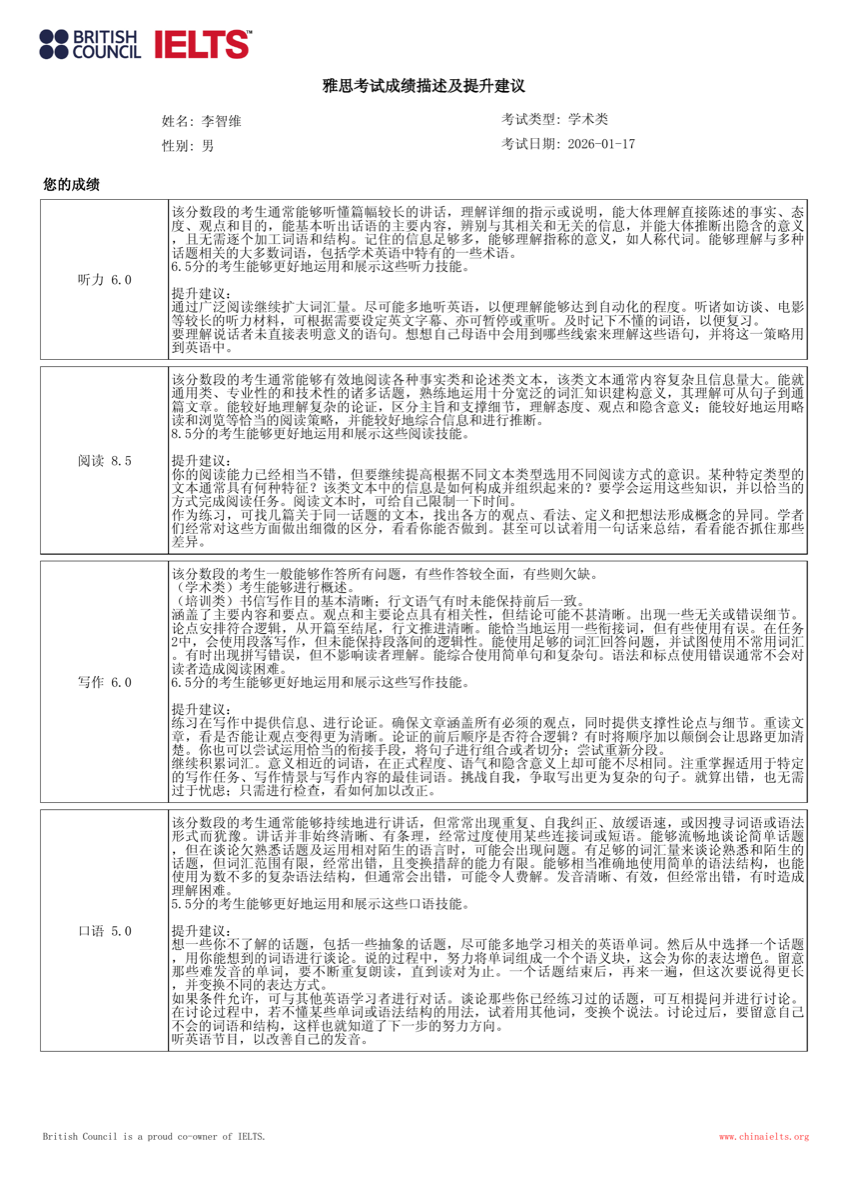 IELTS Score Report — Chinese version
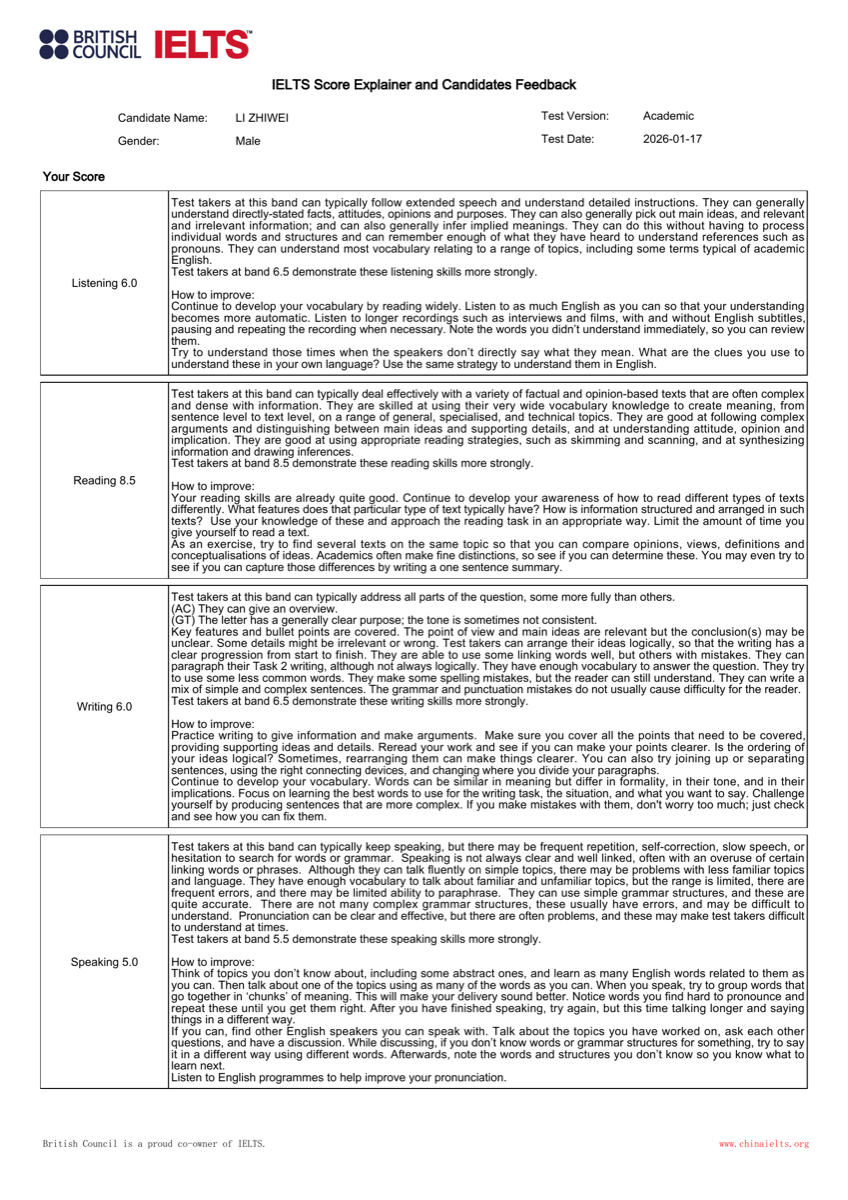 IELTS Score Report — English version
The pattern tells a story: I can read technical papers and documentation with near-native fluency (8.5), but speaking and writing — the productive skills — lag behind. This makes sense for someone who has spent a decade reading code, documentation, and research papers, but has had limited practice in academic writing or formal English conversation.
The British Council’s feedback was precise: “Expand vocabulary via extensive reading; listen to longer English content such as interviews, films with subtitles to build automatic comprehension.” Good advice that I’m actively following.
✍️ Writing & Public Learning
I maintain a public knowledge base at lzwjava.github.io/notes-en with ~8,000 AI-generated notes covering topics from dark mode implementations to GPU compute, Linux kernel internals, and deep learning. My blog has ~400 technical posts at lzwjava.github.io.
Writing publicly serves multiple purposes:
- Accountability: When you publish your learning, you can’t fake understanding
- Searchability: My future self can find what I learned months ago
- Connection: Other engineers find my notes useful and reach out
- Clarity: Explaining something forces you to truly understand it
The blog started as a personal notebook and grew into something bigger. Every technical problem I solve, every model I train, every tool I build — it all goes into the blog. Not because I’m trying to build an audience, but because writing is thinking.
👨👩👧👦 Family
I got married in 2020. My wife is a frontend engineer — she builds user interfaces, I build systems behind them. We complement each other well.
We have two daughters. Our 5-year-old has been watching English YouTube animation for 3 years here in China — her English is already surprisingly natural. She picks up vocabulary, pronunciation, and even humor from the videos. It’s a reminder that language acquisition at a young age is fundamentally different from studying it as an adult.
 Family portrait — Studio Ghibli style
Family grounds you. Startups come and go, code gets rewritten, models get deprecated — but the people who matter stay. My daughters don’t care about my GitHub contribution graph or my LLM token consumption. They care about whether I show up.
👓 Reversing Myopia — A 4-Year Experiment

I started reversing myopia in 2022, inspired by Todd Becker’s 2014 talk “Myopia: A Modern Yet Reversible Disease” and Yin Wang’s 2022 blog post on natural vision restoration. The core idea is simple: wear glasses with a prescription reduced by about 150 degrees for daily use (phone, computer, reading), and let your eye muscles gradually recover their natural shape.
Over four years, my results:
| Time | Left Eye Myopia | Left Eye Astigmatism | Right Eye Myopia | Right Eye Astigmatism |
|---|---|---|---|---|
| 2022.03 | -3.50 | -2.25 | -5.75 | -1.75 |
| 2023.04 | -3.00 | -1.25 | -5.00 | -1.25 |
| 2024.11 | -2.50 | -1.00 | -4.25 | -1.25 |
| 2025.08 | -3.00 | -1.00 | -5.00 | -1.00 |
Both myopia and astigmatism reduced by roughly 100 degrees. The progress isn’t linear — there are plateaus and setbacks — but the trend is clear.
I’ve shared this method with around 1,000 people in my surroundings. About 15 of them have been running the experiment alongside me for years, seeing reductions of 100 degrees or more. Some netizens found me through my articles — parents of primary school kids with 400 or 500 degrees of myopia, desperate for an alternative to surgery. The method works, but it requires patience and consistency. Most people who try it seriously see results within 6-12 months.
I wrote three papers documenting the journey: Experimental Verification, The Principle of “Just Barely Clear”, and Natural Vision Restoration Tips.
🎯 Philosophy & Influences
My technical philosophy is heavily influenced by Yin Wang (王垠) — a Chinese programmer known for his deep, sometimes controversial critiques of programming languages, operating systems, and the software industry. His writing taught me to:
- Question accepted wisdom
- Think from first principles
- Prefer simplicity over complexity
- Be intellectually honest about what I don’t understand
Paul Graham shaped my entrepreneurial thinking. His essays on startups, wealth, and hacking taught me that:
- Startups are about making something people want
- The best ideas seem obvious in hindsight
- Working with great people matters more than working on great ideas
Andrej Karpathy showed me what deep technical work looks like when combined with clear communication. His nanoGPT, micrograd, and YouTube tutorials demonstrate that you can be both deeply technical and widely accessible.
These influences converge in how I work: build things, write about them publicly, question everything, and keep learning.
📊 Impact — 150 Million People and Counting
Over 12 years of engineering, my code and content have reached more than 150 million people. Not all of it was glamorous — much of it was backend services, SDKs, and blog posts that quietly do their work behind the scenes. Here’s the breakdown:
| Project | Role | Impact |
|---|---|---|
| Chongding Conference (冲顶大会) | Backend engineer | ~50 million users — a mobile trivia app similar to HQ Trivia, one of the hottest apps in China in early 2018 |
| PayMe by HSBC | Backend engineer | ~3 million users — Hong Kong’s leading peer-to-peer payment app |
| LeanCloud | SDK engineer | 200,000+ developers served, indirectly impacting ~50 million end users through apps built on the platform |
| Square Root Software Consultancy | Project Manager | Supervised and managed 50 small software projects, indirectly impacting ~20 million users |
| WeChat Video Channel / YouTube | Content creator | ~2 million views across video content |
| lzwjava.github.io | Writer | ~500,000 readers — 400+ technical posts and 8,000+ AI notes |
The numbers matter less than the pattern: every project I’ve touched, from a 3,500-user campus app at age 19 to a 50-million-user trivia game at 22 to banking infrastructure at 27, has been about building things that real people use. The scale grew, but the intent stayed the same — write code that works, share what I learn, and keep moving forward.
📚 Passed Courses
Self-taught through China’s higher education self-study examination system (自学考试), while working full-time. This is how I earned my degree without attending university full-time — studying on my own schedule, passing exams one by one.
| Course Code | Course Name | Exam Date | Pass Method | Score | Credits |
|---|---|---|---|---|---|
| 08553 | Introduction to Programming—Java | 202601 | Exam | 88 | 4 |
| 14567 | Mobile Application Development Technology | 202601 | Exam | 60 | 5 |
| 13167 | Web Design and Production | 202601 | Exam | 71 | 5 |
| 03706 | Ideological and Moral Cultivation and Rule of Law | 202510 | Exam | 69 | 3 |
| 00040 | Introduction to Law | 202504 | Exam | 60 | 3 |
| 02318 | Computer Organization and Architecture | 202504 | Exam | 66 | 4 |
| 02323 | Operating Systems Fundamentals | 202304 | Exam | 67 | 4 |
| 02316 | Computer Application Technology | 202410 | Exam | 73 | 2 |
| 02142 | Introduction to Data Structures | 202210 | Exam | 75 | 4 |
| 02120 | Database and Its Applications | 202410 | Exam | 68 | 3 |
| 00342 | Advanced Programming Language (I) | 202210 | Exam | 75 | 3 |
| 00022 | Advanced Mathematics (Engineering) | 202404 | Exam | 77 | 7 |
| 00012 | English (I) | 202210 | Exam | 80 | 7 |
| 13794 | Fundamentals of Computer Programming (Practical) | 202604 | Practical | Excellent | — |
| 13808 | Computer Fundamentals and Application Technology (Practical) | 202604 | Practical | Pass | — |
| 13171 | Database and Its Applications (Practical) | 202604 | Practical | Pass | — |
16 courses, 57 credits. Highest score: Java Programming (88). The journey started in 2022 and is still ongoing — balancing self-study with full-time work at HSBC and building AI tools on the side.
🍳 Cooking
I picked up cooking as a practical skill — not as a hobby, but as a way to eat better and save time. The air fryer became my go-to tool: a Midea KZE5004 for around 126 CNY. It replaced my electric oven (my wife vetoed having both — too much clutter in our already-packed kitchen). With it I’ve made fries, chicken wings, roasted chicken, and various stir-fried dishes.
Beyond the air fryer, I’ve learned to make porridge with meat and vegetables, noodle soups, and stovetop stir-fries. The key lessons are simple: oil has a higher boiling point than water so stir-frying heats food more effectively; cut ingredients into small pieces for even cooking; and add ingredients in the right order since broccoli needs more time than mushrooms. A vegetable chopper, mortar and pestle, and parchment paper are underrated tools.
Cooking mirrors programming more than I expected — the same process or function applies to similar ingredients, the order of operations matters, and the goal is always to get the output right (fully cooked, safe to eat).
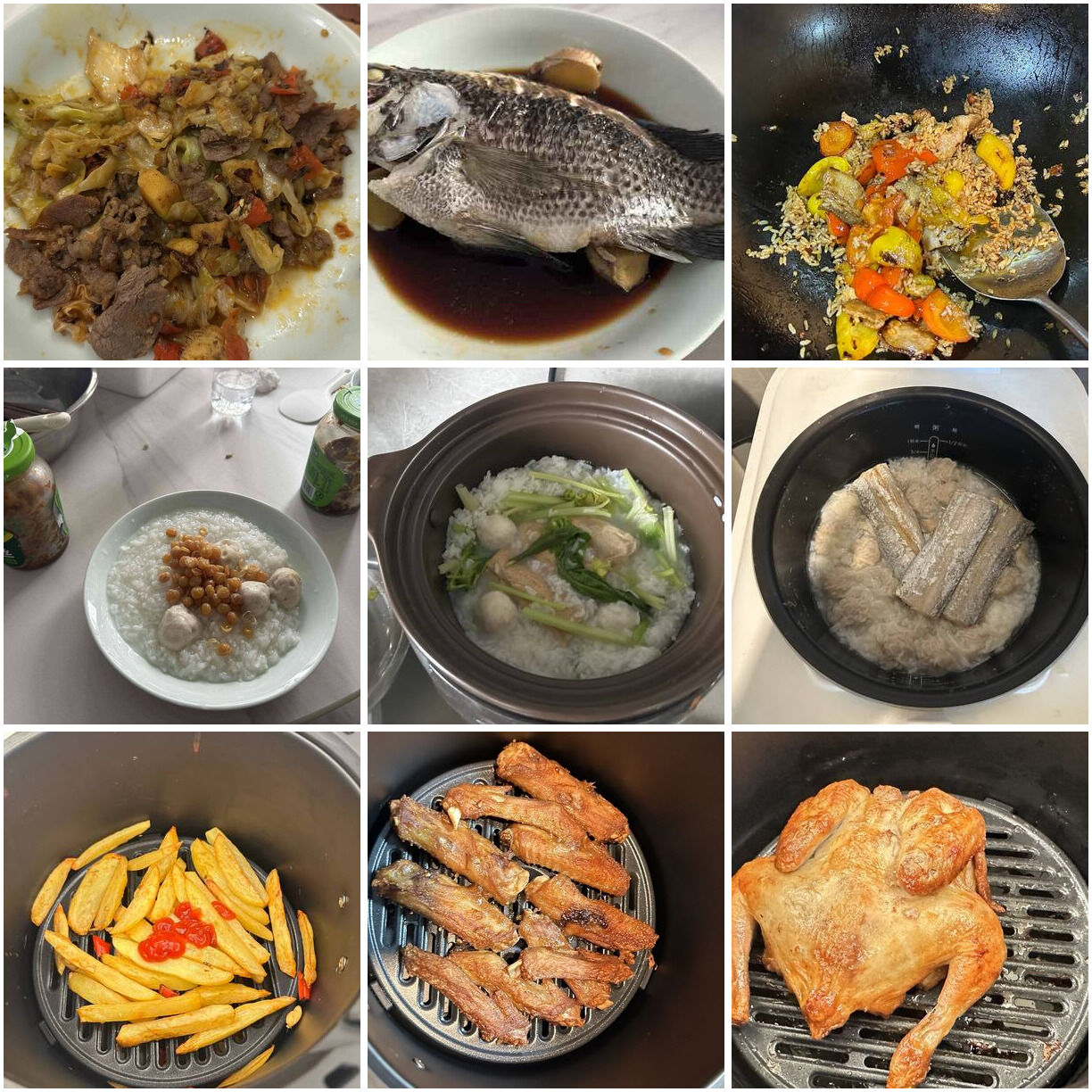 Home cooking — stir-fry, porridge, and air fryer dishes
🏃 What’s Next
The journey continues. I’m transitioning fully into AI engineering — not as a side activity, but as the main career. The goal is deep competency in:
- Training and fine-tuning models
- Agent architectures and LLM systems
- AI-native developer tooling
- GPU compute and inference optimization
But life isn’t just about career optimization. I want to keep writing, keep exploring new places, keep meeting interesting people, and keep questioning my own assumptions. The best engineers I’ve met aren’t just technically excellent — they’re curious about everything.
As I wrote in my CEO post at age 21: “Life is short. We can work at a slow pace for 20-30 years, or we can work intensely for 4 years and earn enough for a lifetime. Travel the world, make a movie, explore nature — there are so many beautiful things we haven’t done yet.”
Eight years later, I still believe that. The specifics have changed — I’m no longer trying to build the next unicorn startup — but the core drive remains: use technology to build a meaningful life, and share what I learn along the way.