Linux Kernel Major Components and Subsystems | Generated by AI
Question: What are the major parts or components in the Linux kernel?
Answer:
The Linux kernel is a monolithic kernel, meaning all core components run in kernel space, but it is highly modular with loadable modules (especially for drivers). Its major subsystems or components are responsible for managing hardware resources, processes, and system services.
Core Subsystems
- Process Management (Scheduler): Handles creation, scheduling, and termination of processes and threads. It ensures fair CPU time allocation among running processes.
- Memory Management: Manages virtual memory, paging, swapping, and allocation of physical memory to processes. It provides each process with its own virtual address space.
- Virtual File System (VFS): Provides a unified interface for different file systems (e.g., ext4, NTFS, Btrfs). It abstracts file operations like open, read, and write.
- Network Stack: Manages network protocols (e.g., TCP/IP), sockets, and communication between systems.
- Device Drivers: Interfaces with hardware devices (block devices like disks, character devices like keyboards, network devices). Most are loadable as modules.
- Inter-Process Communication (IPC): Enables communication between processes (e.g., pipes, shared memory, semaphores, message queues).
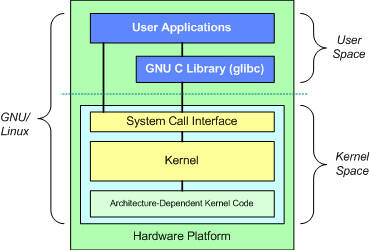
- System Call Interface: The entry point for user-space applications to request kernel services (e.g., via syscalls like
fork(),read()). - Architecture-Specific Code: Handles low-level operations specific to CPU architectures (e.g., x86, ARM).
Other notable parts include security modules (e.g., SELinux), power management, and various block/char/network subsystems.
Here are some illustrative diagrams of the Linux kernel architecture:


References:
- Anatomy of the Linux kernel - IBM Developer
- Conceptual Architecture of the Linux Kernel
- Linux kernel - Wikipedia
- Introduction — The Linux Kernel documentation
- Wikimedia Commons: Linux kernel diagrams
